To track macros is to log the grams of protein, carbohydrate, and fat you eat each day and compare them against a target built from your calorie goal. Since macros make up every calorie you consume, tracking them means you’re tracking calories too, just with more useful detail. Your fastest next step: calculate your daily calorie need, then weigh and log one meal today to see how the process feels.
What you need to start is short:
- A digital kitchen scale
- A tracking app or a plain notebook
- Basic label-reading skills (serving size, grams per macro)
Key Takeaways
Tracking macros works because it turns an abstract calorie goal into concrete, measurable food choices you can adjust weekly based on real feedback.
| Point | Details |
|---|---|
| Macros equal calories | Protein and carbs provide 4 calories per gram, fat provides 9, so grams determine your total intake. |
| Calculate before you track | Estimate TDEE, set a calorie goal, then convert your chosen split into grams using 4/4/9. |
| Weigh food for accuracy | A digital scale beats visual estimation, especially for calorie-dense items like oils and nut butters. |
| Treat targets as guidelines | Database and label numbers vary, so judge progress by weekly trends, not single-day precision. |
| Let Homecooked simplify logging | Homecooked builds meal plans around your macro targets and calculates the breakdown for you automatically. |
Table of Contents
- What Are Macros, Exactly?
- How to Calculate Your Macro Targets
- Common Macro Splits by Goal
- Reading Labels and Estimating Macros in Real Food
- How to Track Macros Day to Day
- Common Tracking Mistakes and How to Avoid Them
- Let Homecooked Handle the Math for You
- Frequently Asked Questions
- Sources
What Are Macros, Exactly?
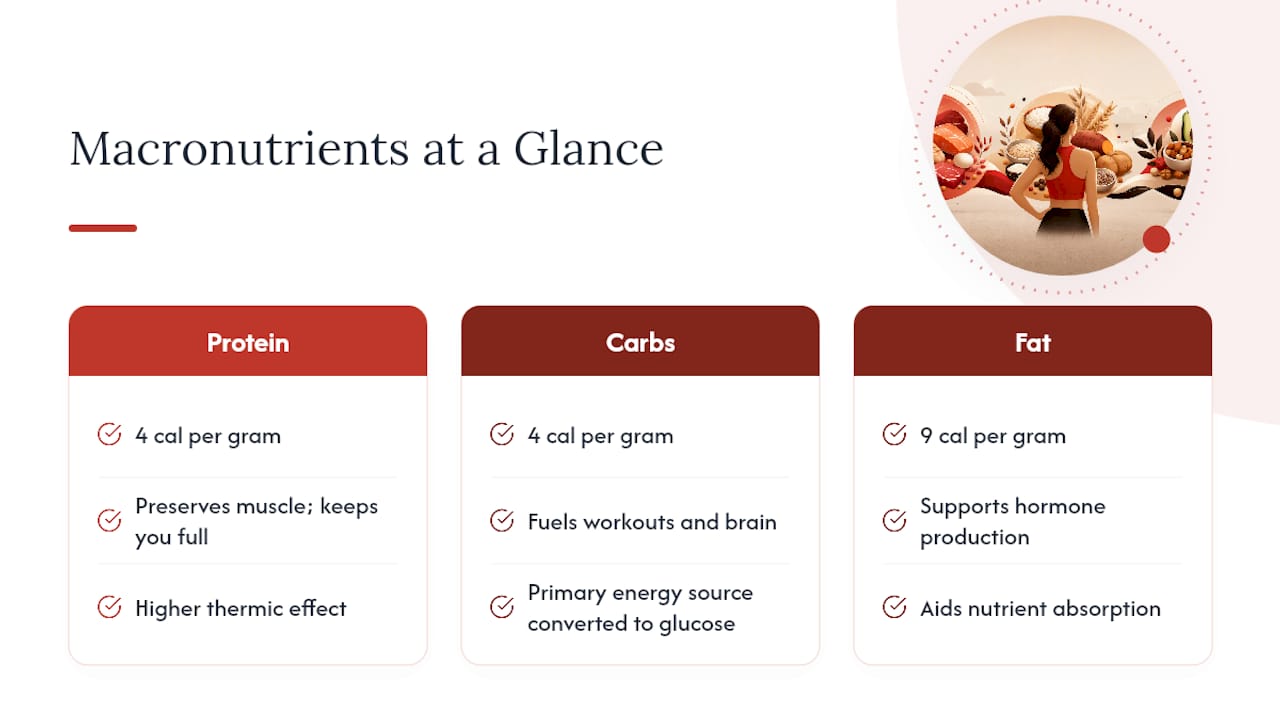
Protein, carbohydrate, and fat are the three macronutrients your body uses for energy and repair. Alcohol technically counts as a fourth, though it’s not something you build a diet around. Each gram converts to energy at a fixed rate: protein = 4 calories per gram, carbohydrate = 4 calories per gram, fat = 9 calories per gram. That’s the entire math behind every macro calculation you’ll ever do.
Balance among the three matters beyond just hitting a calorie number. Protein preserves muscle and keeps you full longer, partly because it has a higher thermic effect than carbs or fat, meaning your body burns slightly more energy digesting it. Carbohydrates fuel workouts and brain function, and the Mayo Clinic notes they’re a primary energy source your body converts to glucose. Fat supports hormone production and nutrient absorption. The Dietary Guidelines for Americans set broad healthy ranges for all three.
How to Calculate Your Macro Targets
Getting your starting numbers takes five steps. None of them require a nutrition degree.
- Estimate your BMR. The Mifflin-St Jeor equation is the standard formula most online calculators use to estimate the calories your body burns at rest.
- Apply an activity multiplier to find your TDEE. Common factors: 1.2 for sedentary, 1.375 for lightly active, 1.55 for moderately active, 1.725 for very active.
- Set your calorie goal. Subtract roughly 500 calories from TDEE for a fat-loss pace of about a pound a week, add 300 to 500 for muscle gain, or hold steady at TDEE for maintenance.
- Pick a macro split based on that goal (more on splits below).
- Convert percentages to grams using the 4/4/9 rule.
Here’s a worked example. Say your TDEE lands at 2,200 calories and you want fat loss, so you set a target of 1,700 calories using a 40% protein, 35% carb, 25% fat split.
- Protein: 1,700 × 0.40 = 680 calories ÷ 4 = 170g
- Carbs: 1,700 × 0.35 = 595 calories ÷ 4 = 149g
- Fat: 1,700 × 0.25 = 425 calories ÷ 9 = 47g
For muscle-focused goals, a simpler rule of thumb works well too: aim for 1.2 to 1.7 grams of protein per kilogram of body weight and build carbs and fat around what’s left. Whichever method you use, treat week one as a rough draft. Check your weight trend every seven days, and if it’s not moving the way you want after two to three weeks, adjust calories by 100 to 200 and keep protein steady.
Common Macro Splits by Goal
Your split should follow your goal, not the other way around. These starting points work for most people, based on commonly used ranges:
- Fat loss: 40% protein / 35% carb / 25% fat. Keeps you full on fewer calories.
- Maintenance/balanced: 30% protein / 40% carb / 30% fat. A sustainable everyday split.
- Muscle gain: 30% protein / 45% carb / 25% fat. More carbs fuel harder training sessions.
- Endurance training: 20% protein / 55% carb / 25% fat. Prioritizes glycogen for long efforts.
- Ketogenic: 20% protein / 5% carb / 75% fat. Requires careful attention to food quality since so many calories come from fat.
If workouts feel flat or recovery is slow, add carbs before cutting anything else. If you’re hungry all day, raise protein or fat before touching carbs.
Reading Labels and Estimating Macros in Real Food
A rough sense of what’s on your plate makes tracking faster and more accurate. Here’s the calorie math again, alongside a couple of everyday examples:
| Macronutrient | Calories per Gram | Example Serving |
|---|---|---|
| Protein | 4 | 3 oz cooked chicken breast: about 26g protein (example only) |
| Carbohydrate | 4 | 1 medium banana: about 27g carbs (example only) |
| Fat | 9 | 1 tbsp olive oil: about 14g fat (example only) |
Nutrition labels list values per serving size, not per package, so check how many servings you’re actually eating and scale accordingly. If a label says one serving is a half cup and you eat a full cup, double every number.
- Use a scale for anything calorie-dense or hard to eyeball, like nut butter, oils, or cheese.
- Hand portions (palm, fist, thumb) work fine once you’ve calibrated them against a scale.
- Restaurant meals and packaged foods vary more than you’d expect. Treat their listed macros as estimates, not exact figures.
How to Track Macros Day to Day
Three approaches cover almost everyone. Weigh-and-log means putting food on a scale and entering it into an app every time. It’s the most accurate method, and Precision Nutrition calls it the most precise option available outside a lab. Hand-portioning trades some precision for speed, useful once you already know roughly what your targets look like on a plate. A mixed approach blends both: weigh everything for two to three weeks while your eye calibrates, then spot-check with a scale every week or two after that.
Whatever method you pick, run through this checklist each time you log a meal:
- Weigh or measure the food before cooking when possible
- Search the item in your app or reference a label
- Confirm the serving size matches what you weighed
- Adjust for oil, sauces, or recipe ingredients you might forget
Daily logging works best in the first few weeks because it’s the fastest way to learn actual portion sizes rather than guessed ones. If building out full meals around your targets feels like the hard part, a tool like Homecooked can generate meal plans that already match your macro numbers, which cuts a big chunk of the daily math.
Pro Tip: Log your meal right after you weigh it, before you eat. Waiting until after means you’re relying on memory, and memory rounds in your favor more often than it should.

Common Tracking Mistakes and How to Avoid Them
The biggest error is skipping the scale and eyeballing calorie-dense foods, which throws off fat and calorie totals fast. Close behind: forgetting liquid calories from coffee drinks, dressings, and alcohol, and trusting a single database entry without checking if it matches your actual product.
Databases and apps are convenient, but The Conversation points out they’re not infallible, since entries and label rounding introduce small errors. Treat your daily number as a guideline, not a law. Better fixes: weigh meals closely for the first few weeks, judge progress by weekly averages instead of single days, and stop chasing exact numbers once you understand your portions.
Pro Tip: Once you can eyeball a chicken breast within 10 grams, you’ve earned the right to put the scale away for most meals and save strict tracking for foods that still trip you up.

Who Actually Benefits From Tracking Macros
Tracking pays off most for people chasing specific body-composition goals, competitive athletes, and anyone still learning what a real portion looks like. If that’s not you, short-term tracking to build awareness, followed by looser habits like hand portions, tends to stick better than tracking forever. Home cooks juggling both goals and grocery lists often do best with meal plans built around their targets from the start, which is exactly the gap Homecooked fills.
Let Homecooked Handle the Math for You
Once your macro targets are set, the real work is turning them into meals you’ll actually cook. Homecooked builds personalized meal plans around your protein, carb, and fat targets, so you’re not doing 4/4/9 math on a napkin before every dinner.
The app converts each recipe into its macro breakdown automatically, generates a grocery list from your plan, and walks you through cooking with step-by-step timers so nothing burns while you’re portioning rice. If you want to see it in action, try a macro-balanced recipe like bibimbap, which packs lean protein, rice, and vegetables into one bowl you can adjust to your own targets. Start a free trial and let Homecooked build your first week of macro-friendly meals for you.
Frequently Asked Questions
Should I track macros or just count calories? Counting macros gives you calorie control plus a check on protein, carb, and fat balance, since macros determine your calorie total anyway. Calorie counting alone can leave you low on protein even while hitting your number.
What’s the best macro tracking app? Any app with a large food database and a barcode scanner works well for most people; the right one comes down to which interface you’ll actually open every day. Consistency matters more than the specific app.
How long should I track macros before easing off? Two to four weeks of consistent logging is usually enough to learn your typical portions and calibrate your eye, a timeline Precision Nutrition recommends before shifting to a lighter-touch approach.
Do I need to weigh food forever? No. Weigh consistently at first, then transition to hand portions once you can estimate common foods within a reasonably small margin.
What if my macro numbers don’t match my app’s calorie count? Small mismatches are normal due to rounding, since apps calculate calories from your logged grams using 4/4/9. If the gap is large, double check your serving size entry.
This article is general information, not a substitute for advice from a qualified doctor. Consult a qualified healthcare professional about your own circumstances before acting on anything here.
Sources
- Dietary Guidelines for Americans 2020-2025
- Calories or macros: nutritionist explains which works best for weight loss or building muscle — The Conversation
- Carbohydrates: How carbs fit into a healthy diet — Mayo Clinic